
"Moving at the speed of 2025 in 2026 means falling behind. Agents transformed AI from a tool we use into a workforce we lead. The question is no longer if you adopt – it’s whether you can rethink how work gets done. In 2026, adaptation speed is the new competitive moat."
The AI Landscape 2026: Four Hypotheses That Matter
The gap between AI’s promise and its enterprise reality has never been wider, or more consequential. While foundation models have become commoditized and agent frameworks proliferate, most organizations still struggle to translate capability into sustained value. The companies that will lead in 2026 and beyond are not those with the most advanced technology, but those that understand the structural shifts underway and act on them decisively.
This chapter presents four hypotheses that define what matters in 2026. They are deliberately pointed. If you find yourself disagreeing, that disagreement is worth examining. It may reveal assumptions that no longer hold due to the technological developments between the time of writing and that of reading.
The game has shifted. The exercises that built AI capability in 2023 (prompt engineering, chatbot pilots, basic RAG implementations) are now table stakes. Staying competitive requires a new training regimen, and the organizations that fail to update their approach will find themselves falling behind, no matter how hard they work.
1. Agents Are a Step Change, Not an Increment
The shift from AI assistants to AI agents is not a feature upgrade. It is a fundamental change in what AI systems can do and what they require from organizations. More profoundly, it transforms AI from a tool to a user, from an instrument that humans operate to a workforce that operates alongside them.
Assistants respond to prompts. They augment human work by generating text, answering questions, or summarizing documents. The human remains in the loop for every decision and action. This is the paradigm most enterprises have operationalized: useful, but bounded.
Agents pursue goals. They decompose complex objectives into subtasks, use tools, interact with systems, and adapt their approach based on intermediate results, often across multiple steps without human intervention. The human defines the objective and constraints; the agent determines how to achieve it.
This distinction has profound implications:
- Autonomy requires trust infrastructure. When an agent can take actions (send emails, modify data, trigger workflows) the question shifts from "Is the output good?" to "Should this action be allowed?" Permissions, guardrails, and audit trails become operational necessities, not compliance exercises.
- Evaluation becomes continuous. A chatbot can be evaluated on response quality. An agent must be evaluated on goal achievement, action safety, cost efficiency, and behavioral consistency across contexts. This demands new metrics and new disciplines.
- Failure modes are different. Assistants fail visibly: wrong answers, poor formatting. Agents can fail silently, taking suboptimal paths, accumulating costs, or drifting from intent in ways that only surface later.
The evidence is compelling. Recent benchmarks like OpenAI's GDPval1 suggest that agentic systems can automate 25–40% of knowledge work tasks with current capabilities, not in theory but in controlled enterprise deployments. The MIT "Iceberg Study"2 documents that the visible productivity gains from GenAI represent only a fraction of the value unlocked when agents are integrated into core workflows.
The question is no longer whether agents work. It is whether your organization can learn to lead them.
For a deep dive into agentic architectures, governance patterns, and implementation strategies, see the appliedAI whitepaper "AI Agents in Action."
2. Context Engineering Becomes a Core Competency
The era of prompt engineering (crafting clever instructions to coax better outputs from language models) is giving way to something more fundamental: context engineering.
Context engineering is the systematic discipline of providing AI systems, especially agents, with the right information, at the right time, in the right structure, to perform optimally. It compasses:
- Data provisioning: Which knowledge sources, documents, and data streams should an agent have access to? How is freshness ensured? How is sensitive information protected?
- Process understanding: What does the agent need to know about the workflow it operates in? What are the upstream dependencies and downstream consequences of its actions?
- Tool access: Which APIs, systems, and capabilities can the agent invoke? Under what conditions? With what permissions?
- Boundary definition: What is the agent explicitly not allowed to do? Where must it escalate to humans? How are these constraints encoded and enforced?
This is not prompt engineering at scale. It is systems design for AI-native operations.
The difference becomes clear when agents fail. Poor prompt engineering produces bad outputs. Poor context engineering produces agents that confidently take wrong actions because they were operating on incomplete, outdated, or inappropriate information. They hallucinate not from model weakness, but from context starvation.
Organizations that treat context as an afterthought will build agents that impress in demos and fail in production. Those that invest in context engineering as a discipline (with dedicated roles, tooling, and governance) will build agents that compound in value over time.
If you are not building context engineering as an organizational capability, you are preparing to deploy agents that will be impressively wrong and could cause real damage.
3. End-to-End Process Redesign Is No Longer Optional
Most enterprises approach AI the same way they approached previous technology waves: identify existing processes, find friction points, apply AI to reduce friction. This is intuitive, low-risk, and almost always suboptimal.
The pattern is familiar:
- Document processing is slow → Add AI-powered OCR (optical character recognition) and extraction
- Customer inquiries take time → Deploy a chatbot for first-level triage
- Sales forecasting is manual → Build a predictive model on historical data
Each intervention delivers local improvement. But the process architecture remains unchanged. And process architecture is where the real constraints live.
This changes the game for use case identification. The bottom-up approach that served enterprises well (collecting use case ideas from business units, prioritizing by feasibility and value, building pilots) remains necessary but is no longer sufficient. When AI can transform entire value streams, organizations need a complementary top-down perspective: Which core processes should be fundamentally reconceived? Where does the current architecture create structural limitations that no amount of local optimization can overcome?
AI becomes a CEO agenda item. Process redesign at this level cannot be delegated to an AI Center of Excellence or buried in IT priorities. It requires executive mandate, cross-functional authority, and willingness to challenge assumptions that have shaped the organization for decades. The CEOs who recognize this will transform their companies. Those who treat AI as a technology initiative will optimize their way to irrelevance.
Consider a typical B2B sales process: lead qualification, needs assessment, proposal generation, negotiation, contract execution, handoff to delivery. Adding AI to each step (lead scoring, meeting summarization, proposal drafts) yields incremental gains. But the structure assumes human-to-human interaction at every stage, with handoffs, approvals, and waiting time built into the flow.
An AI-first redesign asks different questions: What if qualification, needs assessment, and initial proposal happened in a single continuous interaction? What if the agent had real-time access to pricing, inventory, and delivery constraints, eliminating the "let me check and get back to you" delays? What if the human entered only for high-stakes negotiation and relationship decisions?
This is not automation. It is process reconception.
The companies that augment existing processes with AI will see 10–20% efficiency gains. The companies that redesign processes around AI capabilities will see step-change improvements of 10x and more. This will be impossible to catch with incremental optimization. Organizations that embed AI into broken processes are automating their inefficiencies at higher speed.
4. Adaptation Speed Is the New Competitive Moat
There is a persistent confusion in enterprise AI discussions between adoption and adaptation.
Adoption is acquiring and deploying AI capabilities: rolling out copilots, standing up a GenAI platform, training employees on prompt techniques. It is necessary but insufficient.
Adaptation is changing how the organization works in response to AI capabilities, and continuing to change as those capabilities evolve. It includes:
- Redesigning roles and responsibilities as agents take on tasks
- Updating governance frameworks as new risk patterns emerge
- Shifting investment from human capacity to human-agent orchestration
- Accelerating learning cycles to incorporate new model capabilities within weeks, not quarters
The half-life of AI best practices is now measured in months. An organization that took 18 months to operationalize GPT-4 patterns will find those patterns obsolete before they scale. The winners are not those with the best initial implementation, but those that can iterate fastest.
This requires a different organizational posture:
- Governance that enables speed: Lightweight approval processes for low-risk use cases, with clear escalation for high-risk ones. Not uniform heavyweight review for everything.
- Experimentation infrastructure: The ability to test new models, agents, and workflows in controlled environments and promote successes rapidly.
- Continuous capability building: Not one-time training programs, but ongoing upskilling that tracks the technology frontier.
- Leadership fluency: Executives who can make informed trade-offs on AI investments without relying solely on technical teams to frame options.
The traditional competitive moats (proprietary data, scale, brand, distribution) still matter. But they are increasingly necessary rather than sufficient. The new moat is the speed at which an organization can learn to work differently.
In 2026, the winners will not be those with the best AI. They will be those who learn fastest to work with imperfect AI productively.
The Cost of Inaction
The risks of moving too fast with AI are well-documented: governance failures, reputational incidents, wasted investment, employee backlash. These risks are real and must be managed.
Equally consequential are the risks of moving too slowly. Companies that don't move ahead fall behind as the competition advances. Organizations that remain at the Experimenter or early Practitioner level face a compounding disadvantage:
- Talent attrition: High-performers increasingly expect to work with modern AI tools. Organizations perceived as AI-laggards will struggle to attract and retain the people who drive innovation.
- Cost structure divergence: As competitors automate knowledge work, their cost per transaction drops. The gap between AI-enabled and AI-limited cost structures will widen each year.
- Customer expectation mismatch: B2C companies have set a new bar for responsiveness and personalization. B2B customers increasingly expect the same, and AI-enabled competitors will deliver it.
- Strategic optionality loss: Many AI capabilities require foundational investments in data, platform, and skills. Organizations that defer these investments will find themselves unable to respond when competitive pressure intensifies.
- Regulatory preparation gap: The EU AI Act and similar regulations require documentation, risk assessment, and governance capabilities. Building these under time pressure is expensive and error-prone.
The cost of inaction is not static. It compounds.
AI Maturity Redefined: Framework, Levels & Investment Fields
Knowing that AI matters is no longer the challenge. Knowing what to do (in what sequence, with what investment, measured against what benchmarks) is where most organizations struggle.
This chapter introduces the appliedAI Maturity Framework: a structured approach to assessing, planning, and advancing enterprise AI capabilities. It reflects our work with leading organizations across industries and our role in national AI maturity initiatives across Europe.
Think of AI maturity like organizational fitness. Just as physical fitness requires training across multiple dimensions (strength, endurance, flexibility, coordination) AI maturity requires building capability across strategy, technology, data, people, and execution. And just as a fitness program must be calibrated to current condition and goals, AI initiatives must be sequenced based on where an organization stands and where it needs to go.
The technology shifts described in Chapter 1 have changed what "fit" means. The training regimen that built capability in 2023 is no longer sufficient. Organizations must recalibrate their understanding of what each fitness level requires and adjust their training accordingly.
The appliedAI Maturity Framework: A Brief Introduction
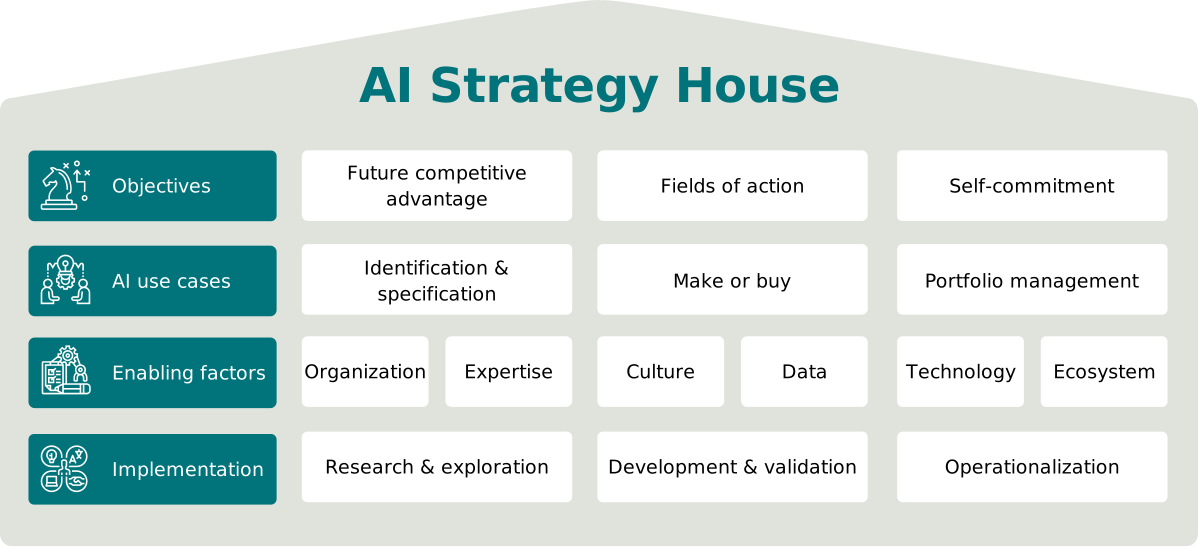
The appliedAI Maturity Framework provides a comprehensive view of the capabilities required to create sustained value from AI. It is built on two core structures: nine strategic dimensions of AI adoption and four maturity levels.
Nine Dimensions that cover the full scope of enterpriseAI capability:
| Dimension | Scope |
|---|---|
| AI Ambition & Steering | Strategy, governance, compliance, value measurement |
| Use Cases | Discovery, prioritization, product thinking, process integration |
| Organization | Operating model, roles, accountability |
| Expertise | Skills, enablement, knowledge management |
| Culture | Adoption, responsibility, change readiness |
| Data | Strategy, quality, access, privacy |
| Technology | Platform, architecture, tooling, security by design |
| AI Ecosystem | Vendors, models, partners, IP, cost/FinOps |
| Execution | Delivery, lifecycle, LLMOps/MLOps, evaluation, operations |
These dimensions are not independent. Progress in one often requires, or enables, progress in others. Data quality constrains what Use Cases are feasible. Organizational structure determines how Execution scales. Ambition without Expertise produces failed pilots.
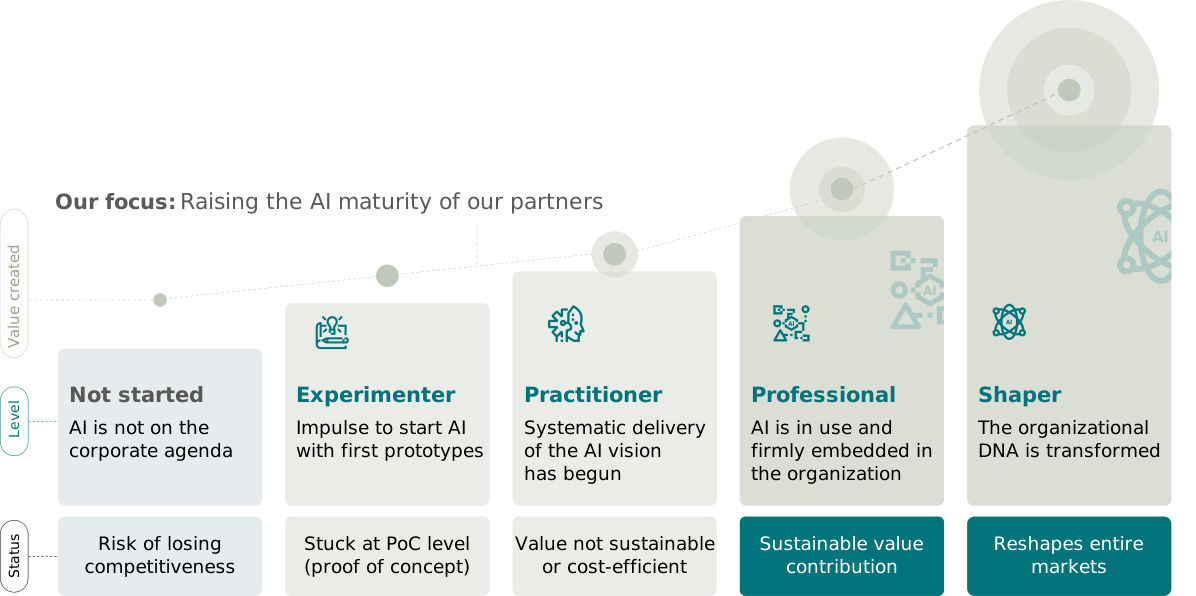
Four Maturity Levels that describe the progression from initial experimentation to industry leadership:
| Level | Name | Characteristic |
|---|---|---|
| L1 | Experimenter | Active experimentation; pilots underway; governance emergent |
| L2 | Practitioner | Operational use in selected areas; repeatable delivery emerging |
| L3 | Professional | Scaled enterprise capability; governance embedded; value measured |
| L4 | Shaper | AI as organizational DNA; continuous optimization; ecosystem influence |
The framework is not a maturity ladder to be climbed uniformly. Organizations may be at different levels across dimensions, and that is expected. What matters is understanding where you are, where you need to be, and what specific capabilities will close the gap.
This framework is used by leading national initiatives to assess AI maturity across entire industries in multiple European countries. It provides the foundation for benchmarking, strategic planning, and capability building at scale.
For the complete framework, including detailed subdimensions and assessment methodology, see the appliedAI whitepaper "Elements of a Comprehensive AI Strategy."
Industry Benchmark: Where Companies Stand at the Time of Assessment
The following analysis is based on 187 maturity assessments conducted by appliedAI and partners across Europe in the past years. It provides a snapshot of where organizations actually stand, not where they believe they stand or where vendor marketing suggests they should be. The participants range from public institutions to large corporations. The smallest participants have several hundreds of employees; the largest are among the biggest companies in Europe.
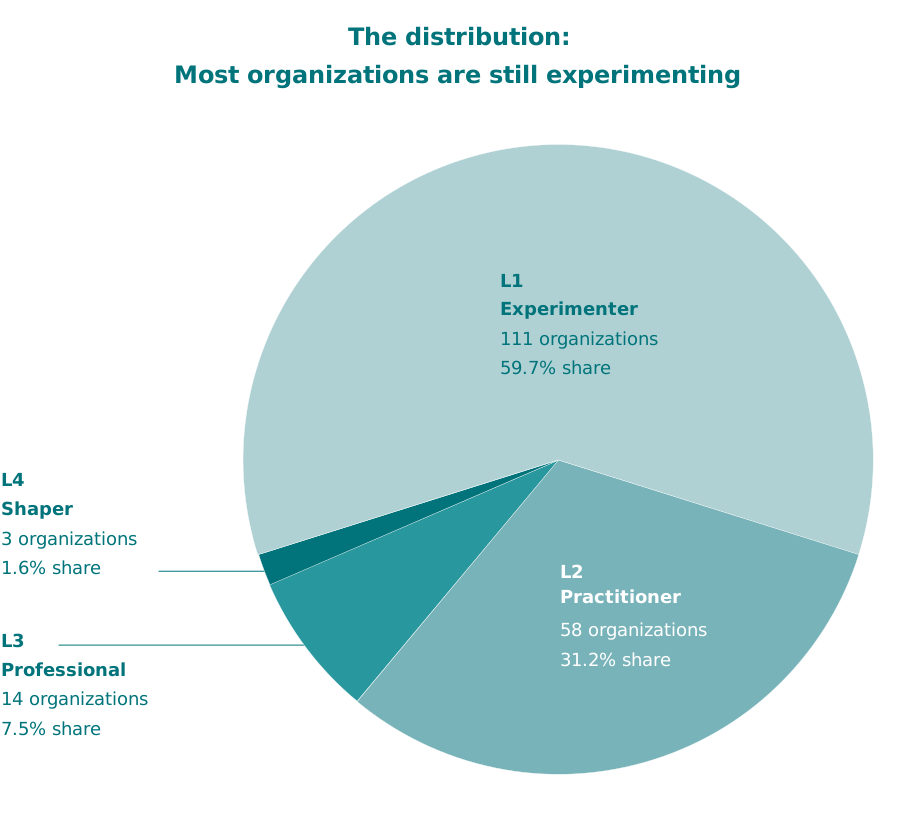
The headline finding: nearly 60% of organizations remain at Level 1, active experimentation without reliable paths to production value. Only 9% have reached Professional or Shaper levels where AI is embedded as enterprise capability.
This is not a criticism nor do we consider this as statistically valid research. In particular, there might be selection biases on company and participant levels. It is a reflection of where companies are and where they struggle.
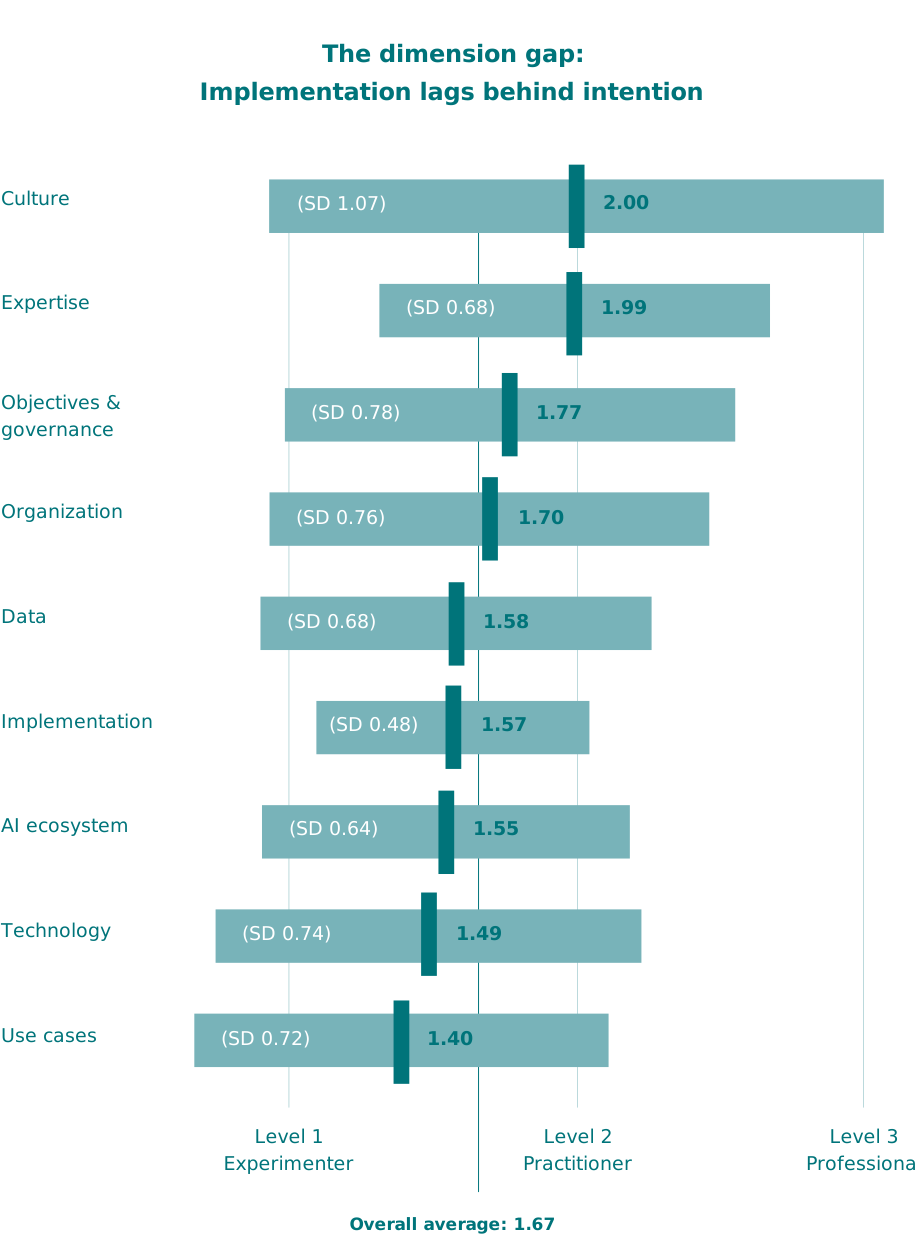
The pattern is consistent and telling:
Strongest dimensions: Culture, Expertise, Ambition & Steering (avg. 1.92)
Organizations have intent. Leadership recognizes AI matters. Employees are curious and increasingly skilled. The "soft" foundations are being built.
Weakest dimensions: Use Cases, Technology, AI Ecosystem (avg. 1.48)
Operationalization lags. Organizations struggle to move from ideas to production, from pilots to scaled value, from enthusiasm to governance. The "hard" capabilities that convert intent into results remain underdeveloped.
The gap is 0.44 points, nearly half a maturity level. This is the execution gap that separates organizations that talk about AI from those that generate value with it.
What the Spread Reveals
The standard deviation column tells its own story:
- Culture shows the highest variance (1.07): Some organizations have built genuine AI-positive cultures; others face resistance or indifference. There is no industry norm. Culture is a differentiator.
- Execution shows the lowest variance (0.48): Most organizations struggle here equally. This is not a capability some have cracked while others lag. It is a shared challenge, which suggests structural barriers rather than individual organizational failures.
- Ambition & Steering varies significantly (0.78): The spread between cautious experimenters and aggressive transformers is wide and strategic positioning on AI might further diverge, not converge.
Key Interpretation
Three patterns deserve executive attention:
1. The intent-execution gap is structural. Organizations are not failing because they lack ambition or awareness. They are failing because operationalization (Use Cases, Technology, Execution) requires capabilities that most have not yet built. The investment fields in Section 2.5 address exactly this gap.
2. Level 1 is crowded, Level 3+ is not. The competitive separation is happening now. Organizations that remain at Experimenter level for another year will find the gap to leaders increasingly difficult to close.
3. Variance in Culture and Ambition & Steering signals strategic divergence. Organizations are making different bets. Some are treating AI as transformational; others as incremental. The success of startups pursuing few-person unicorn approaches indicates that the more disruptive approaches might be the right path to follow.
The benchmark is not a leaderboard. It is a diagnostic. The question is not "where do we rank?" but "what specific capabilities must we build to move from where we are to where we need to be?"
Download the full whitepaper and the AI Maturity Matrix poster free of charge now to access all relevant information and insights on the evolution of AI agents and their safe adoption.