

Most enterprise AI agents share the same structural flaw: they forget. After every session, context is lost, relationships reset, decision history erased. For simple assistants, that is tolerable. For agents expected to manage complex, multi-step tasks over time, it is an architectural failure.
This whitepaper investigates why memory has become the central design challenge for long-running AI agents — and how organizations can make the right architectural decisions. It surveys the major memory approaches, explains the tradeoffs behind each, and demonstrates through a comparative experiment which architectures preserve which kinds of value: from factual recall and goal continuity to the retention of behavioral patterns across sessions.
Key Takeaways:
- Memory is an architectural requirement, not a feature. As AI agents move beyond single interactions, memory becomes part of the core system design — not an optional add-on.
- Context replay is not true long-term memory. Early approaches simulate continuity by reusing prior conversation history. They do not provide durable, reliable memory across extended tasks and sessions.
- Different architectures preserve different kinds of value. Some designs excel at storing explicit facts, others at retaining goals or behavioral patterns. The right choice depends on what the agent needs to remember.
- Cognitive continuity matters more than simple recall. Effective memory must help an agent recover and use past information in ways that support consistent reasoning and behavior over time.
- Memory should be evaluated through sustained interaction. The experiment reinforces that memory systems should be judged not only by isolated recall, but by how well they support performance, coherence, and continuity across longer-running tasks.
Authors:
Mingyang Ma — Head of Agentic AI Solutions Development, appliedAI Initiative GmbH
Harsh Gurawaliya — Junior AI Engineering LLM, appliedAI Initiative GmbH
Dr Malte Nalenz — Generative AI Engineer, appliedAI Initiative GmbH
1. Why Early AI Systems Could Not Remember
Imagine using an AI assistant throughout your workday. It helps summarize documents, review code, and think through technical problems. In one conversation, you explain your project architecture, describe a deployment issue, and ask for suggestions. The assistant responds helpfully and appears to understand the situation.
The next day, you return and ask a follow up question. The assistant responds as if none of the earlier discussion ever happened.
This was not simply a product flaw or a temporary limitation. It reflected a deeper architectural reality: early Al systems were not designed to preserve memory across interactions. They could process the information provided in a request, but they were not built to carry that information forward over time.
Understanding this limitation is the starting point for understanding why memory became such an important problem in modern Al systems.
Stateless Language Models
The first generation of large language model applications operated as stateless inference systems. A prompt was submitted, the model generated an output, and the transaction ended. On the next request, the model processed a new prompt without any inherent awareness of what had happened before.
At a conceptual level, the interaction could be reduced to a simple pattern:
response = LLM(prompt)
The model could only reason over the information available inside that prompt at inference time. Anything omitted from the input was functionally absent from the model's world.
This follows directly from how transformer based systems were designed.¹ They are highly effective at processing a sequence presented in the current call, but they do not natively preserve persistent state between separate calls.
In practical terms, the model can reason about the text it receives now, but it does not automatically carry knowledge forward to future interactions.
This distinction matters because it separates fluency from memory. A model may sound consistent, informed, and context-aware within a single exchange while still lacking any durable way to retain information across time.
The Context Window as Temporary Working Memory
To make early Al systems feel more coherent across a conversation, developers began reintroducing prior messages into each new prompt. If the assistant needed information from earlier exchanges, the application would resend that material along with the current request.
This approach relies on the context window: the amount of text a model can process in a single inference call. As context windows expanded, systems became capable of handling longer conversations, larger documents, and more complex instructions within one request. In practice, this expansion was dramatic: early widely used systems operated with only a few thousand tokens of context, later models extended that capacity to more than one hundred thousand, and eventually some systems pushed beyond the million-token range. These increases made models more useful for extended conversations and large-scale document handling, but did not create durable memory across time.
Expanding the context window did not change the fundamental limitation. It improved short-term recall within an interaction, but it did not create persistent memory across time.
A context window is therefore best understood as temporary working memory rather than long-term memory. On each new request, the system must decide what prior information to include, what to summarize, and what to leave out. The model does not retain the past on its own; it can only reason over whatever reconstructed context it is given in the current call. This analogy was made explicit in MemGPT, which compared the limited context window of language models to the limited capacity of human working memory.
This distinction is important. Early systems could appear coherent across a session, but that coherence depended primarily on prompt reconstruction and application level logic, not on a persistent memory architecture designed for longterm behavior.
The Structural Limits of Context-Based Memory
As developers pushed these systems into real workflows, the limits of context reconstruction became increasingly visible.
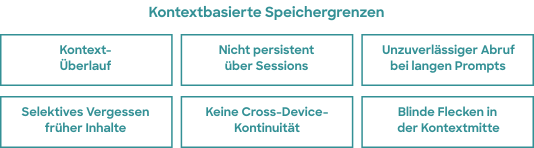
First, context overflows. When conversations, documents, or tool traces exceed the available window. earlier information must be removed, summarized, or truncated. The result is selective forgetting. Important project details, prior decisions, or earlier constraints can disappear simply because they no longer fit.
Second, context is not persistent. Session history exists only so long as an application stores and resubmits it. Once the user leaves, switches devices, or starts a new thread, continuity must be recreated externally. Without storage outside the model, the system has no durable memory of prior interactions.
Third, long prompts do not guaranteе reliable recall. Even when more text fits into the window, models do not treat all parts of the prompt equally. This limitation was highlighted in Lost in the Middle: How Language Models Use Long Contexts, which found that model performance often drops when relevant information appears in the middle of a long context rather than near the beginning or end. In other words, more space does not automatically produce better continuity. It can simply create a larger area in which important facts become harder to retrieve.
It is also worth noting that alternative architectures do not automatically solve this problem. Systems such as Mambа and related state-space models offer linear-time sequence processing and maintain a form of recurrent state, but they still do not provide cross-session memory by themselves. Their internal state resets between separate calls, just as a transformer's key-value cache does. Persistence still requires something outside the model itself.
Together, these limitations revealed an important truth: context alone is an unstable foundation for memory.
Why This Became a Major Constraint for Al Agents
For narrow, one-off tasks, stateless systems are often sufficient. A model that answers a single question, summarizes a document, or drafts a paragraph may not need to remember anything beyond the immediate request.
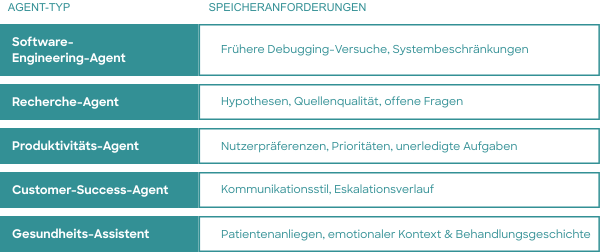
That changes once Al systems begin operating as agents rather than isolated responders. An agent is expected to work across multiple steps, maintain objectives, use tools, adapt to intermediate results, and return to ongoing tasks over time. In that setting, memory is no longer a convenience. It becomes essential. A software engineering agent should remember prior debugging attempts and system constraints. A research agent should retain working hypotheses, source quality assessments, and open questions. A productivity agent should preserve user preferences, recurring priorities, and unfinished tasks. Without memory, each interaction begins too close to zero. The system may remain articulate, but it cannot accumulate understanding.
This is where the limitations of early architectures became operationally significant. What looked acceptable in a chatbot became a serious bottleneck in agentic systems.
Early Attempts to Compensate
The first wave of solutions treated memory as an application layer workaround. Developers appended chat history, inserted summaries of previous exchanges, and used lightweight frameworks to preserve continuity across short sessions. These techniques were useful and, in many cases, necessary. But they remained extensions around a stateless core.
As systems became more autonomous and workflows stretched over longer time horizons, the limits of these methods became more apparent. Conversation history, summarization, and prompt compression could preserve useful context, and in many systems they remain an important part of the overall design. However, on their own, these techniques often struggle to provide the durable, structured, and selectively retrievable memory required by more demanding long-running agents.
That realization marked an important shift in thinking. Memory could no longer be framed as a prompt engineering trick. It had to be treated as a core systems problem: what should be stored, how should it be retrieved, when should it be updated, and how should it shape future behavior.
This shift set the stage for the next phase in Al system design: the move from temporary context reconstruction to explicit memory architectures.
2. The Evolution of Agentic Memory
Early language-model applications simulated memory rather than possessing it. When continuity was required, developers inserted previous conversation turns into the next prompt. This improved short-term coherence, but it did not create persistent memory: once the prompt was gone, the system had no durable representation of the past.
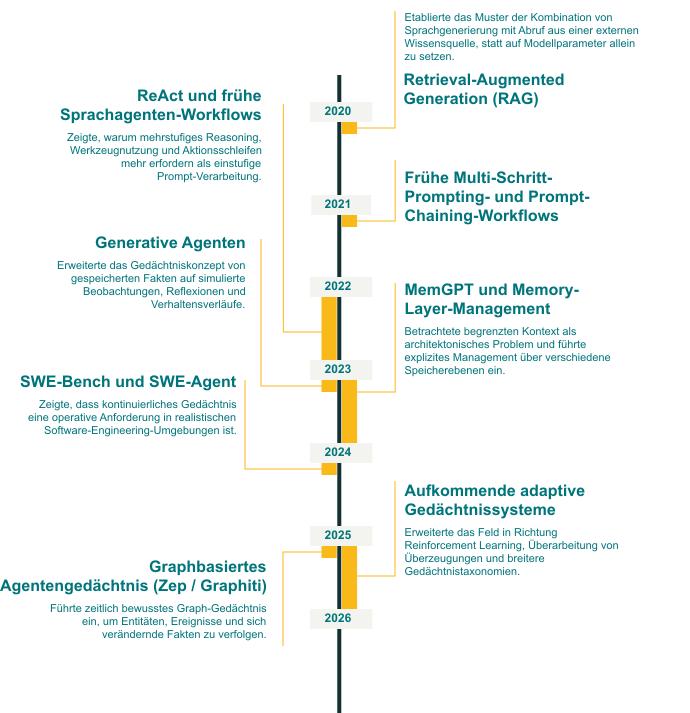
As Al systems evolved from conversational interfaces into more autonomous agents, this limitation became much harder to ignore. Agents were expected to pursue goals across multiple steps, use tools, react to intermediate results, and return to unfinished work. In that setting, replaying fragments of conversation was no longer enough. An agent needed to retain information, retrieve it when relevant, and integrate it into later reasoning. The development of agent memory from roughly 2020 to 2026 can therefore be understood as a transition from prompt reconstruction toward more explicit memory architectures integrated into the design of the agent itself. These milestones are not a strict taxonomy, but they clarify the broader shift from temporary context handling toward deliberate memory design.
Prompt-Level Continuity
The earliest practical technique for maintaining context was conversation replay. Applications stored earlier messages and appended them to new prompts so the model could "see" recent interaction history. Frameworks added buffering, sliding windows, and summarization to make this manageable.
For simple assistants, this was often good enough. It let the model respond as if it remembered what had just been discussed. But the memory remained fragile: the system's apparent recall depended entirely on the context window and on how the application assembled each prompt. Important details could be truncated, summarized away, or omitted.
Conversation replay therefore preserved fragments of dialogue, but it did not create persistent memory.
The Rise of Autonomous Agents
These limits became much clearer when developers began building autonomous agents. Unlike chat assistants, these systems were expected to decompose goals, plan across multiple steps, use tools, and adapt to intermediate results. ReAct is a good early example: it interleaved reasoning traces with actions and showed strong results on ALFWorld and WebShop, making clear that multistep performance depends on tracking what has already been observed and attempted.
The same pressure appeared in practical software tasks. SWE-bench evaluates agents on real GitHub issues across full repositories, and SWE-agent was built to search, navigate, edit, and test code autonomously inside those environments. In settings like these, continuity stops being a UX nicety and becomes an operational requirement: the agent must keep track of what it has inspected, changed, and tried.
Early agent systems also exposed how unstable long horizon behaviour could be without good memory. Projects such as Auto-GPT 14 popularized goal loops and task decomposition, but they also highlighted how easily agents could revisit the same ideas, lose track of prior outcomes, or depend on brittle prompt state.
This is why memory became more than a convenience feature. In Generative Agents, behavior is shaped not only by stored observations, but also by retrieval and higher level reflection over time. The broader lesson was that once agents are expected to operate over extended horizons, they need a way to accumulate and reuse experience rather than repeatedly reconstructing the present from scratch.
Retrieval-Augmented Memory
A more durable step emerged when developers began attaching external storage systems to language model applications. Instead of relying only on prompt history, systems could store information independently and retrieve relevant items during later interactions.
This design pattern is closely related to retrieval-augmented generation, or RAG. Lewis et al. introduced RAG as a framework that combines a language model with a retriever accessing an external knowledge index, allowing generation to be informed by retrieved information rather than relying only on parametric memory.
In agent systems, this idea extended beyond document retrieval. Memory stores could hold user preferences, task information, project context, or past events. When a new query arrived, the system could search the memory store for relevant items and inject the results into the model's working context.
This significantly improved continuity across sessions. More importantly, it marked a shift toward treating memory as a distinct system component rather than relying primarily on replaying or compressing prior conversation. At the same time, retrieval-based memory introduced its own limitation: stored information remained useful only if the retrieval mechanism surfaced at the right moment. Relevant context could remain stored but unused.
From Stored Facts to Stored Experiences
A second conceptual shift followed. Researchers and system designers began exploring whether agents should store not only isolated facts, but also experiences.
This changed the role of memory. Instead of preserving only discrete pieces of information, memory could represent events, observations, prior decisions, and patterns of interaction over time. A debugging assistant may need to recall which fixes were already tried and why they failed; a research assistant may need to remember earlier hypotheses and how later evidence changed them.
Generative Agents made this idea especially visible by combining observation, retrieval, reflection, and planning so that later behavior depended on accumulated prior experience rather than on isolated stored facts alone. Facts support recall. Experiences support behavior.
Persistent memory therefore became more than a database optimization. It became a mechanism for maintaining continuity in reasoning and action.
Memory as a Hierarchical System
As memory systems matured, another important design insight emerged: not all memory should be handled in the same way.
The model's context window came to be understood as a form of working memory, useful for immediate reasoning but limited in capacity and duration. External storage served as a longer-term memory layer, preserving information across sessions and over longer time horizons. Some architectures added summaries or specialized stores to bridge the gap between the two.
MemGPT made this shift especially explicit by treating limited context as a systems problem and proposing managed movement across memory tiers rather than assuming that everything relevant should remain in the active prompt at once.?
Once memory is framed this way, the design problem becomes more sophisticated. The question is no longer simply what to store, but what belongs in active context, what should remain in persistent storage, what should be abstracted into higher-level knowledge, and what should be forgotten.
Graph Memory and the Move Toward Infrastructure
By the middle of the decade, memory was no longer just an auxiliary feature added to chat applications. It was becoming an infrastructure layer for intelligent systems. Agent frameworks increasingly incorporated persistent state, structured workflows, and mechanisms for maintaining continuity across longer processes and across multiple collaborating agents.
An important part of this shift was the emergence of graph based memory systems. Rather than storing memory only as isolated text fragments or embeddings, these systems began representing entities, events, and their relationships in more structured form. Zep, built on the Graphiti engine, is a useful example: it introduced a temporally aware knowledge-graph approach that can track not only what was stored, but when something happened and how it changed over time.10 This helps address weaknesses that retrieval-only systems often face, including temporal reasoning, entity resolution, and changing facts across long running interactions.
This change reflected a broader realization across the field: advanced agents cannot rely on prompt tricks alone. They require memory architectures that support persistence, retrieval, abstraction, and adaptation over time. The path from RAG, to ReAct-style agent loops, to reflection-based agents, to tiered memory systems and more structured graphbased memory makes that progression visible.
What began as a workaround for stateless models was becoming a foundational component of Al system design.
From Continuity to Architecture
The evolution of agent memory reflects a transition from temporary continuity to durable system design. Early systems simulated memory by replaying conversation history. More advanced systems externalized memory, retrieved it selectively, and increasingly treated it as a structured component of the agent architecture itself.
Memory was no longer just a convenience feature. It was becoming essential to how agents operate. The next challenge, however, was not simply how to store more information. It was how to organize and retrieve information in ways that preserved meaning rather than noise.
That is the design problem addressed in the next chapter.