

In this article
About this benchmark
Disclaimer: These findings come from a benchmark among appliedAI partner companies, a self-selected peer group of enterprises already committed to AI. They describe the practice of that group, not the wider market, and should not be presented as a representative market study.
appliedAI partner companies answered a survey about their AI products between May and June 2026. The report shows which products they use, how they rate their main provider, and which parts of the stack have no common practice. The next survey runs in November 2026.
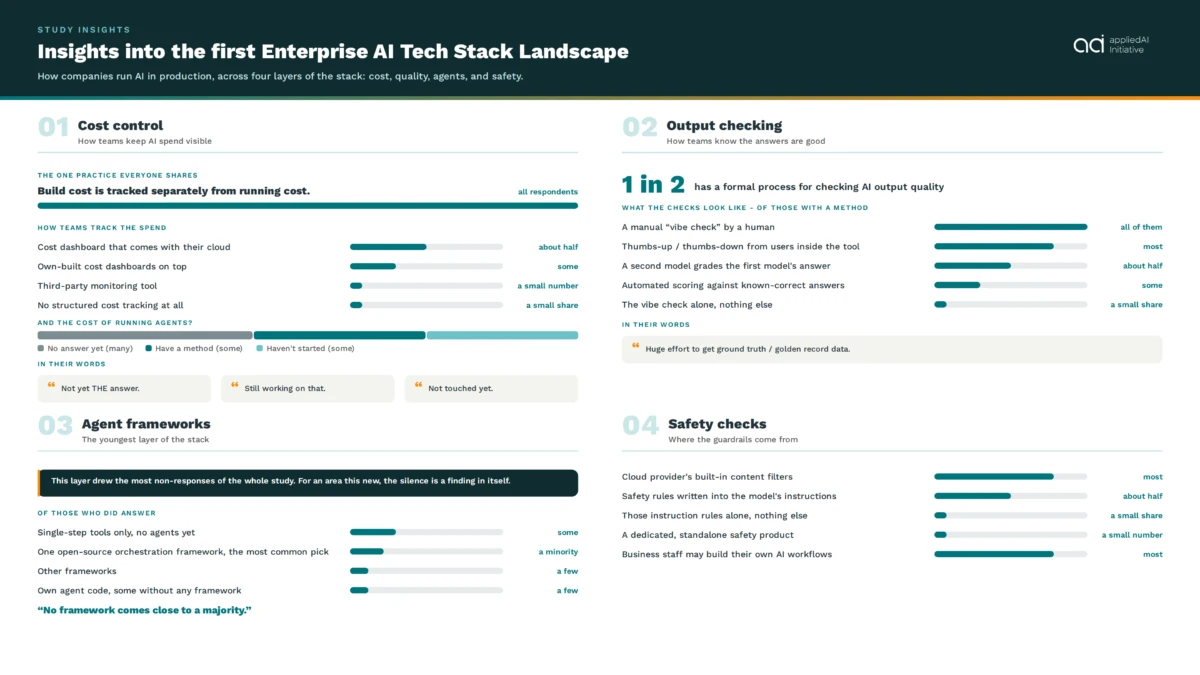
A snapshot of AI Tech Stack Survey results. Aggregate figures, anonymized, no vendor or company names.
Key Takeaways
Settled at the top, unsettled at the bottom.
The foundational layers of the stack, cloud, retrieval and workflow automation, have settled on shared defaults. The newer and more autonomous layers, agent frameworks above all, have no common practice yet. The decisions that are still genuinely open have moved down the stack, and that is where each company is largely on its own.
The biggest choices were inherited, not competed.
For most companies, the largest infrastructure decision followed an existing commercial relationship rather than a fresh head-to-head comparison. The layers beneath it then tend to inherit that choice.
Deployment has moved ahead of verification.
Companies are shipping AI faster than they are building the means to check it. Cost tracking, output-quality evaluation and safety guardrails are consistently the least mature parts of the stack, even as access widens and more business users start building their own workflows.
Cost is the main pain point.
The hardest unsolved problem turns out to be a basic one: knowing what AI costs. It ranks above reliability and above proving return on investment. Financial attribution and tooling lag behind the pace of adoption, and the controls that do exist tend to cap exposure rather than actively manage it.
Similar stacks, very different strategies.
Partners run strikingly similar tools but combine them in very different proportions. Build versus buy turns out to be a portfolio decision, driven by what each company treats as core to its business rather than by technology. And a steady appetite for running AI on their own infrastructure cuts against the idea that enterprise AI is only cloud consumption.
Where value is laying now
The layers everyone has agreed on are the easy part. The value now sits where there is no shared default yet - putting agents into production responsibly, evaluating output quality, and getting a real grip on cost.
The stacks are converging faster than the practices around them. The partners who pull ahead now are the ones getting a grip on cost, quality and control, not just picking the right tools.
Want to help shape what comes next and get access to exclusive insights?
As an appliedAI partner you help shape future benchmarks and get the full results before anyone else. Learn more about the partnership.