


You've given your team access to Copilot or ChatGPT. A few people use it daily. Most tried it once. The board asks about AI at every meeting. You nod and say you're working on it.
But if someone asked you to point to a single process that AI has measurably improved - a shorter cycle time, a lower cost per unit, a higher win rate - could you?
For most Mittelstand companies, the honest answer is no. Not because the technology doesn't work. But because nobody has done the hard thinking about where it should work.
The problem isn't adoption. It's direction.
The data is sobering. An MIT Sloan Management Review study (“Scaling AI”, 2025) found that 95% of enterprise AI pilots failed to deliver measurable financial returns. PwC’s 28th Annual Global CEO Survey, released at Davos in January 2025, found that 56% of CEOs reported no cost or revenue benefits from AI. Only 12% saw both.
These numbers reflect large enterprises with dedicated AI teams and seven-figure budgets. For a Mittelstand company with 500 employees, no data science department, and an IT team focused on keeping the ERP running, the odds are even steeper.
The typical pattern: someone rolls out a general-purpose AI tool. Employees use it to draft emails and summarize PDFs. Usage looks decent on a dashboard. But nothing changes in the business. No process gets faster. No margin improves. The managing director looks at the license cost and wonders what exactly the company is paying for.
Understand the three levels of AI - and where to focus
To find the value, it is crucial to understand the three different levels, how companies can “apply AI”. All three have a role. But they differ fundamentally in what they do for your competitive position.
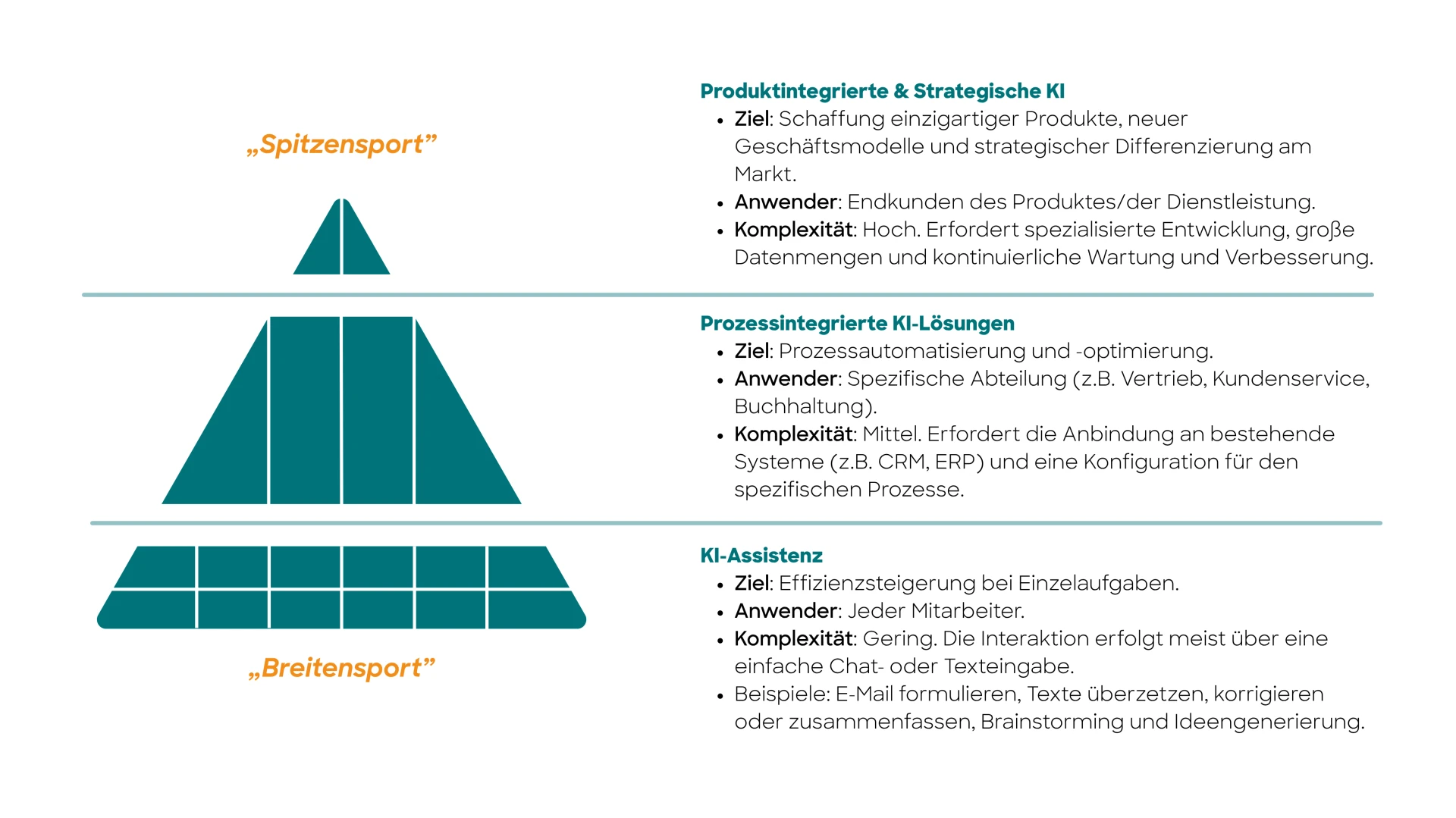
The three levels of AI adoption: from AI assistance to process-integrated solutions to product-integrated strategic AI.
Everyday AI is the base - general-purpose AI tools that help individual employees complete tasks faster without changing the underlying business process. Copilot, ChatGPT, Claude: tools that make individuals faster at drafting emails, translating documents, brainstorming ideas. This layer matters, and you should invest in it. It builds AI literacy across the organization. It creates trust in the technology. It helps people discover what’s possible. And in a tight labor market, it makes your company a more attractive place to work - especially for younger talent who expect these tools.
But Everyday AI doesn't change your competitive position. It optimizes individuals, not systems. The person writes a better email, but the process that required the email in the first place hasn't changed. You cannot transform a company by making its existing workflows 15% more comfortable.
Product-integrated AI is the top - the Elite Sport. Building AI directly into your products or creating entirely new AI-powered offerings. A sensor manufacturer that uses AI to offer predictive maintenance as a service. A specialty chemicals company that builds an AI-powered formulation assistant for its customers. The impact here can be transformational: new revenue streams, structural differentiation, higher margins.
This isn't science fiction for the Mittelstand. Many world-market-leader companies have exactly the kind of deep domain expertise and proprietary data that AI can amplify. But it's not where you start. These initiatives require specialized engineering, significant investment, and long time horizons. Get your organization comfortable with AI first, prove value on concrete processes, and then extend into product innovation from a position of strength.
Process-integrated AI is the middle. Process-integrated AI means taking a specific business process - order processing, proposal generation, quality inspection, customer service, invoicing - and fundamentally redesigning it end-to-end with AI: eliminating handoffs, automating decisions, and connecting systems that currently operate in silos. Not just speeding up individual steps, but changing how the entire workflow operates.
For most Mittelstand companies, this is where the competitive leverage is right now. It's where the largest number of high-impact opportunities exist, with a realistic path to execution and measurable results within months - not years.
What the middle looks like in practice
Consider a mid-sized industrial supplier that responds to 200 RFPs per month. Each proposal takes a sales engineer four hours to compile - pulling specs from the product database, matching requirements, assembling pricing, writing the cover letter. The company wins about one in five.
An AI-integrated version of this process reads the incoming RFP, extracts the key requirements, matches them against the product catalogue, suggests pricing building blocks, and produces a first draft of the proposal. The sales engineer reviews and refines instead of building from scratch. Time per proposal drops from four hours to one. The team handles the same volume with fewer errors and faster turnaround. Win rates go up because proposals arrive sooner and are more precisely tailored.
That's a structural improvement to the economics of the sales operation. It's the kind of change that giving everyone a chatbot will never produce.
Why the middle is hard - but not impossible
Process-integrated AI requires three things in parallel: understanding the business problem deeply enough to pick the right process, building a solution that actually works in production, and getting the team to change how they work.
These capabilities rarely sit in one person. In the Mittelstand, they barely sit in one team. The operations manager who knows every bottleneck in the order process doesn't know how to build an AI workflow. The external developer who could build it doesn't understand why the ERP is configured the way it is. And even if both do their jobs perfectly, the 30 people who use the process daily will revert to their old habits unless someone actively manages the change.
This is where deep process knowledge becomes the critical asset. In Mittelstand companies, that knowledge often sits with people who've been with the company for 20 years. They know exactly where the workflow breaks, which workarounds exist, and why things are done the way they are. They are the most valuable people in any AI initiative - and they are almost never in the room when AI decisions get made.
Here's the good news: AI itself is making the building dramatically faster. AI-assisted development tools mean that prototyping a process automation that used to take eight weeks can now happen in days. The technical barrier has dropped significantly.
But faster building only helps if you're building the right thing. The things that remain stubbornly slow are: figuring out which process to target, understanding its edge cases, and getting people to actually adopt the new way of working. AI accelerates the construction. It does not accelerate the thinking or the behavior change.
What this means for Mittelstand leaders
If you're a managing director or owner of a company between €100 million and €1 billion in revenue, the strategic question isn't whether to use AI. It's where to focus to create real competitive advantage.
Deploy Everyday AI broadly - it builds the foundation of skills and trust you'll need later. Keep Product AI on your radar - depending on your business model, it may become your most powerful lever over time. But start generating measurable value in the middle. The proposal process that takes too long. The quality inspection that relies on one person's eyes. The customer service workflow that has six handoffs before a ticket gets resolved. The invoice reconciliation that eats two FTEs worth of time every month.
Pick one. The one that is clearly broken, operationally significant, and owned by someone who actually wants to fix it. Then assemble the right combination of business knowledge, technical capability, and change management to get it done.
This is where competitive advantage lives for the Mittelstand. Not in the technology itself - your competitors have access to the same models. But in the depth of your process understanding and the speed at which you can turn that understanding into operational improvement. That’s a moat no one can copy. For mid-sized industrial and manufacturing companies asking how to implement AI without a data science team, the answer lies in process-integrated AI - and in starting with the one process where the cost of inaction is already visible.
How we help: the appliedAI SME Accelerator
This is exactly what we built our AI Accelerator for SMEs to do.
It's a structured, cohort-based program that takes mid-sized companies from an honest assessment of where they stand to a live, working AI application in 90 days. Not a strategy deck. Not a pilot that sits on a shelf. A working solution in a real process, with your team trained to operate and extend it.
The program combines three things that mirror the three capabilities the middle layer demands: we help you identify the highest-value process to target (business acumen), we build the solution with you using proven, no-code and low-code approaches that don't require a data science team (technical execution), and we enable your people to actually adopt and own it (change management).
Over 250 companies, including 23 DAX-40 corporations, have worked with appliedAI. The SME Accelerator brings that same expertise to mid-sized companies — scaled to your reality, not a corporate playbook.
If you're ready to move from "we use AI" to "AI changed how we operate," get in touch.